Yellowfin tuna and bluefin tuna: the differences
Yellowfin and bluefin tuna are two different species of the same genus, Thunnus. Yellowfin is Thunnus albacares, which the Italian Ministry of Agriculture's official list of fish names (in Italian) calls tonno a pinne gialle. Bluefin is Thunnus thynnus, which the Ministry calls tonno o tonno rosso, literally "red tuna". Yellowfin lives in the warm seas of the three oceans and is not found in the Mediterranean. Bluefin lives in the North Atlantic and the Mediterranean, where it spawns, and it is the largest of the tunas. At Carpaccio Fish Restaurant, Via Sicilia 45, the tuna on the menu is yellowfin: it is in three carpaccios and one tartare.
Yellowfin, bluefin, albacore: the official names
As with spigola and amberjack (both articles are in Italian), the name to look for on the tag is the one on the Ministry's list, written next to the scientific name. For the tunas of the genus Thunnus the list gives these names:
- Thunnus thynnus: tonno or tonno rosso (bluefin);
- Thunnus albacares: tonno a pinne gialle (yellowfin);
- Thunnus obesus: tonno obeso (bigeye);
- Thunnus alalunga: alalunga (albacore);
- Thunnus orientalis: tonno del Pacifico or tonno oceanico (Pacific bluefin);
- Thunnus maccoyii: tonno australe (southern bluefin).
At the Italian fish counter, then, the bare word tonno means bluefin, while the other species each have a name of their own. People say "pinna gialla" in the singular, and so does our menu; the official form is "a pinne gialle".
How to tell them apart
The ICCAT manual, from the International Commission for the Conservation of Atlantic Tunas, describes yellowfin as long and streamlined, with a metallic blue-black back and golden flanks. The first dorsal fin is bright yellow, the second dorsal and the anal fin a paler yellow. In some large fish, from 120 centimetres up, these two fins become very long, up to a fifth of the fish's length. The finlets, the small fins in a row toward the tail, are yellow too, with a thin black edge.
In bluefin the back is dark blue and the belly silvery white. The first dorsal fin is yellow or bluish, the second, taller, reddish brown. The pectoral fins are very short, less than 80% of the length of the head.
The most obvious difference is size. The largest yellowfin on record measured 239 centimetres and weighed 200 kilos, and the maximum age given for the species is eight years. Bluefin can grow beyond 4 metres: the official maximum weight is 726 kilos, and a fish of 685 kilos was reported in the catches of the Italian tuna traps. On average, ICCAT writes, a ten-year-old bluefin is about 2 metres long and weighs 150 kilos; at twenty it reaches around 3 metres and 400 kilos.
Where they live: yellowfin in warm seas, bluefin in the Mediterranean
Yellowfin lives in open water, in the tropical and subtropical waters of the Atlantic, Indian and Pacific oceans, up to the 45th-50th parallel north and south. According to ICCAT it is absent from the Mediterranean. It spends more than 90% of its time in water around 22 degrees.
Bluefin lives throughout the North Atlantic and the neighbouring seas, above all the Mediterranean. Of all the tunas it has the widest range, and it is the only large open-sea fish that lives permanently in the temperate waters of the Atlantic. It withstands temperatures from 3 to 30 degrees while keeping its body temperature steady.
It spawns once a year, between May and June, in water above 24 degrees: around the Balearic Islands, Sicily, Malta and Cyprus, and in the Gulf of Mexico. Aristotle and Pliny the Elder already described its migrations in the Mediterranean. In 1777 the naturalist Francesco Cetti, in his Storia naturale della Sardegna, wrote that tuna enter the Mediterranean from the Atlantic to lay their eggs around Sicily and then leave the same way.
For centuries Mediterranean bluefin was caught with tuna traps (tonnare) and beach seines, the first industrial fisheries in the area. From the sixteenth century the traps gradually took the place of the seines. ICCAT keeps the catch records of eight tuna traps across Portugal, Sardinia, Sicily and Tunisia, from 1599 to 1960.
The rules on bluefin fishing
Eastern Atlantic and Mediterranean bluefin has a multiannual management plan adopted by ICCAT, which the European Union applies through its own rules. These ban catching, keeping on board, landing, selling or offering for sale bluefin under 30 kilos or under 115 centimetres fork length, even as bycatch or in recreational fishing. In some special cases the threshold drops to 8 kilos or 75 centimetres.
For comparison, ICCAT writes that in the eastern Atlantic and the Mediterranean bluefin reaches maturity at 110-120 centimetres, or 25-30 kilos, at about four years old.
Yellowfin tuna on the menu in Via Sicilia
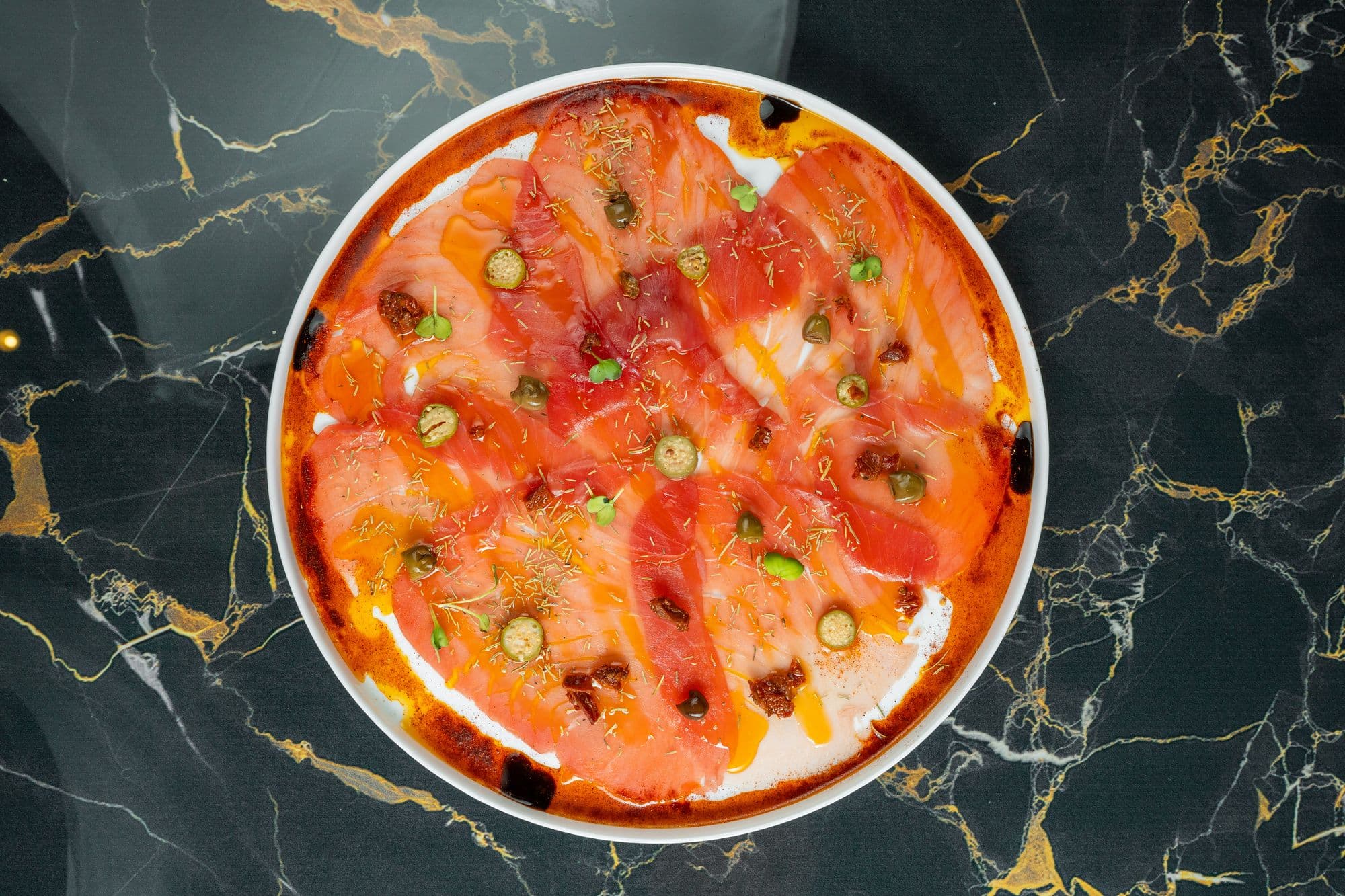
On our menu the tuna is always yellowfin. You will find it in three carpaccios and in the Fusion tartare. The Cacciatora, the Mediterraneo and the tartare cost €20, the Roastbeef di Tonno €22.
Two of the three carpaccios stay with Mediterranean flavours. In the Cacciatora the yellowfin is dressed with balsamic vinegar, cacciatora-style oil, rosemary, pimentón, olives, capers and sun-dried tomatoes. The Mediterraneo has burrata cream, Cantabrian anchovies and crunchy bread. The Roastbeef di Tonno looks to Japan instead, with miso sauce: the tuna comes lightly seared, with rosemary and mustard mayo.
In the Fusion tartare the tuna is paired with artichokes and guanciale crumble, two ingredients from Roman cooking, then kataifi, ginger mayo and lemon gel.
Address, opening hours and booking
Carpaccio Fish Restaurant is at Via Sicilia 45, 00187 Rome, a short walk from Via Veneto and next to Carpaccio Beef Restaurant. For lunch we are open Monday to Friday, from 12:30 pm to 3:30 pm. For dinner we are open Monday to Friday from 7:00 pm to 10:30 pm, and on Saturday from 7:00 pm to 11:00 pm. We are closed on Sunday. The cover charge is €2 at lunch and €3 at dinner.
The full menu is on the menu page. To book, call +39 06 5575012 or use the Book button on the site.
See the Carpaccio Fish menu
MenuFrequently asked questions
Is canned tuna bluefin?
Not necessarily. Canned tuna falls under a European rule: under the name "tuna" a producer may sell preserves of albacore, yellowfin, bluefin, bigeye, other species of the genus Thunnus and skipjack. The word "tuna" on a can, on its own, does not say which of these species is inside.
Are albacora and alalunga the same tuna?
No, but the names change from one language to another and they are easy to mix up. In the ICCAT manual the yellowfin is yellowfin tuna in English, albacore in French and rabil in Spanish, and among the local Italian names are tonno albacora and tonno monaco. In English, though, albacore is the alalunga, Thunnus alalunga, which the rules on preserves also call "white tuna".