Red shrimp, blue-and-red shrimp, rose shrimp and mazzancolla: how to tell them apart
These are four names for four different species, and all four appear in the official list of commercial names kept by Italy's Ministry of Agriculture. The giant red shrimp (gambero rosso) and the blue and red shrimp (gambero viola) come from the sea floor, hundreds of metres down. The deep-water rose shrimp (gambero rosa) is the one Mediterranean fleets land in the greatest quantity. The mazzancolla is a fourth species with a name of its own. Anyone buying shrimp at the counter, or reading one on a menu, does well to know which one is meant.
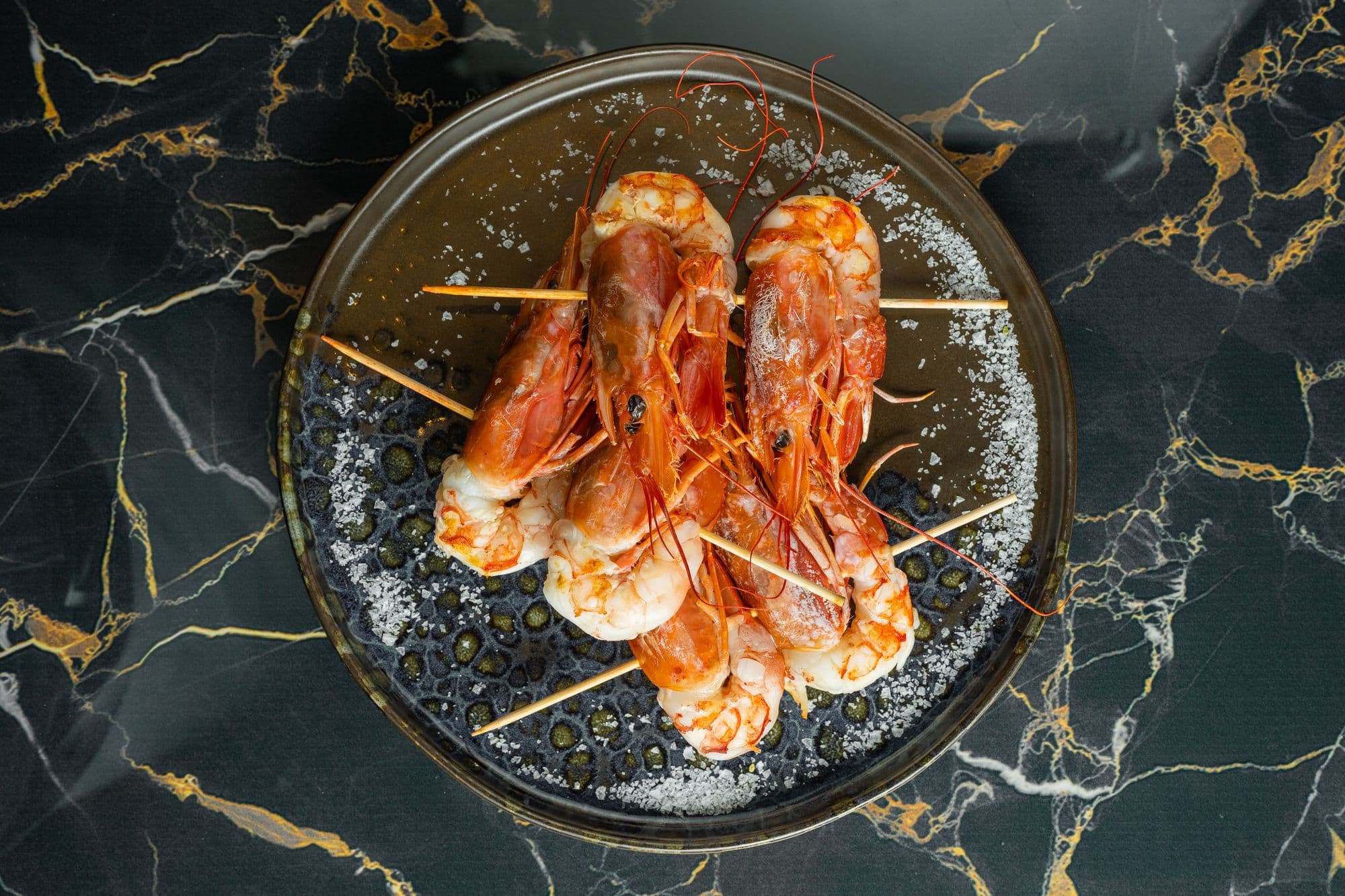
Four names, four species
The ministry's list gives each species an Italian name. For the shrimps we are interested in it says:
- Aristaeomorpha foliacea, gambero rosso (giant red shrimp);
- Aristeus antennatus, gambero viola (blue and red shrimp);
- Parapenaeus longirostris, gambero rosa (deep-water rose shrimp);
- Melicertus kerathurus, mazzancolla (caramote prawn).
The first two belong to the family Aristeidae, the last two to the Penaeidae. They are distant relatives, which is why they live in different places and are fished in different ways.
The scientific name of the mazzancolla is still often written in its older form, Penaeus kerathurus. If you meet it in a text, it is the same species: the official list now uses Melicertus.
Giant red and blue and red shrimp: two deep-water species
The FAO sheet on the giant red shrimp describes a single colour: a uniform scarlet red. Sizes differ between the sexes: males reach 17 centimetres, females 22.5. The most common sizes are 13 to 14 centimetres for males and 17 to 20 for females. It lives on muddy bottoms at depths between 120 and 1,300 metres, and females usually reach sexual maturity in summer.
Another FAO sheet, from the MedSudMed project that studies the resources of the central Mediterranean, narrows it down: abundance of the giant red shrimp peaks between 300 and 800 metres, and in the Sicilian Channel the species clearly prefers depths of 500 to 700 metres. The same sheet says the species is an important target for bottom otter trawlers working on the continental slope of the Strait of Sicily. The FAO sheet on fishing methods adds that trawling is semi-industrial in Spain, Algeria, the Ligurian Sea, Sicily and Israel, and artisanal elsewhere, and that the species is regularly sold in markets in Spain, Morocco, Algeria, Sicily, Liguria and Israel, fresh, chilled or frozen.
The blue and red shrimp is its twin species. The same sheet explains that the two are the only members of the family Aristeidae living in the Mediterranean, and that they take turns across the basin. The blue and red shrimp becomes less abundant from west to east. In Spanish waters it outnumbers the giant red shrimp. In the central Mediterranean and the eastern Ionian Sea, the giant red shrimp dominates.
The MedSudMed sheet gives no depth range for the blue and red shrimp, so we do not write one. It does carry a note on the giant red shrimp in the Sicilian Channel: according to the scientific bodies the sheet cites, the stock is considered subject to overfishing, although only the female component was assessed, and at the time of the sheet there were no formal management objectives. It is a snapshot with a date, not a final verdict, which is why we put it here as something to follow.
The rose shrimp: the most fished
The deep-water rose shrimp, Parapenaeus longirostris, lives higher up than the two above and occurs throughout the eastern Atlantic and the Mediterranean. The document notes that what is known about its ecology comes mainly from the central and eastern Mediterranean, where it is more abundant than in the west. An FAO document on the south-central Mediterranean finds it mainly on sandy and muddy bottoms between 100 and 400 metres, with an overall range from 20 to 750 metres. Small individuals gather at the edge of the continental shelf, larger ones along the slope. The difference shows in the catch: the smallest end up in the nets at 50 to 200 metres, the largest beyond 200.
It is a short-lived species that grows fast and reproduces all year round. The document's aim is to lay the basis for a harmonised management regime across Italy, Tunisia and Malta, which fish the same resource in the same stretch of sea.
One figure shows how much this species weighs in the market. Between 2000 and 2008 the rose shrimp was the most important crustacean by weight among those landed by Mediterranean trawlers, making up 23 per cent of all crustaceans.
The mazzancolla
The mazzancolla belongs to the same family as the rose shrimp. Here we stay with what we have verified: the official name is "mazzancolla" and the species is Melicertus kerathurus. We do not write size, habitat or season, because we have not read an official sheet that gives them in full. A line too few is better than a wrong line. For the same reason, a generic entry such as "shrimp" in a list is not enough to tell which species ends up on the plate: you need the precise name, and until it is there we say so.
How to read the counter
If the word "shrimp" stands on its own, it does not say which species you are looking at. The European rules on fishery products require the label to give the commercial name and the scientific name, the production method, the catch or farming area and the category of gear used.
The scientific name is the key. If the label says Aristaeomorpha foliacea, it is the giant red shrimp. If it says Parapenaeus longirostris, it is the rose shrimp. If there is no scientific name, it is worth asking: whoever sells fish can say which species is on the counter, and if they cannot, that is already information. A correct name is worth more than an adjective. In our article on the swordfish label you will find the full list of required information.
Carpaccio Fish Restaurant in Rome
Carpaccio Fish Restaurant is at Via Sicilia 45, in Rome. The menu page shows what we serve, with dishes named as they are written on the menu. To book, use the Prenota button on the website, or call +39 06 5575012.
See the Carpaccio Fish menu
Menu